I designed the UX and UI of the Mynzo app, where employees and individuals see their carbon emissions and are guided to act on them, through features that help them learn, connect with colleagues and choose more sustainable products.
My role
UI and UX designerResearch, flows and screens
Platform
Mobile appFor employees and individuals
Users
Employees of partner organisationsAnd individual (retail) users
Focus
EngagementLearn, belong and act
My role
UI and UX designer
I worked on the Mynzo app as both the UI and the UX designer. We had little first-hand information about our users, so I researched our audience from published studies, then designed the experience and the screens. The problem and the build priorities were set with the business, and I have kept that line clear below.
What I owned
Research into our audience
The UX and UI of each feature
The quiz content rules
The feed layout and the look of the app
What the team and business decided
The problem and the goals
Which ideas were built, and when
How the app works
One app for the company, its employees and individuals
Organisations hire Mynzo to cut their carbon emissions by a set year. The Mynzo app is where their employees take part.
1OrganisationSigns up with Mynzo and sets a year to cut emissions
2EmployeesEach one joins the app on their own
3MynzoTracks each employee's emissions
4LandThe organisation buys land for its employees to offset them
Tracked automaticallyLocationFollows the commute from home to office
Asked at onboardingQuestionsCover the rest, like the ACs they use
Outside an organisationIndividualsJoin on their own and track personal emissions
01Understand the problem
The problem
People could see their emissions, but not what to do about them
The app tracked emissions automatically and showed them clearly. What it did not show was the next step. A user could see a number, but had no way to know how to bring it down, or what changes to make in their own life. As a sustainability platform, we were not giving users enough value: what to do, how to do it, and people to do it with.
Problem statement
Users can see their emissions in Mynzo, but they do not know how to reduce them. The app has not given them enough guidance, or a community, to turn that knowledge into action.
Business goal. Help users understand and reduce their emissions, and keep them engaged with the app while they do.
Where people spend time
People give time to apps that give something back
From my research, people spend time on apps that give them something in return. A sustainability app is not one of these by default. Employees often join because their organisation asked, which is a reason to sign up once, not a reason to keep returning.
They get something
Shopping
A purchase, an offer, a thing they wanted.
They learn something
News
Knowledge they can use or talk about.
They enjoy it
Reels and video
Entertainment they come back to by habit.
So Mynzo needed to give people something to learn, people to do it with, and sustainable choices they can make, so that the app is worth their time and not only a duty.
Who it is for
The organisation buys, every employee uses
Mynzo has two kinds of audience. The organisation is the customer and sets the target. Employees and individuals are the people using the app every day, and they decide whether the target is met.
21–22Starting their first job58–60Typical retirement age
The app is for every employee of a partner organisation, so it covers the whole working life. India has no official retirement age in the private sector. Employees typically retire at 58 or 60, depending on the contract and the employer. Source
The customer
The organisation
Contracts Mynzo, sets the year to reduce emissions by, and buys land for its employees.
User
Employees
Their professional emissions are tracked, and they are asked work-related questions when they join.
User
Individuals
Not linked to any organisation. They track their personal emissions, with personal questions at onboarding.
The personas below draw on this research and on how the app reaches people, through their organisation or on their own. They run from people who already care to people who have not thought about it yet.
62% · 59%felt worried or anxious about climate change in the past month
25% · 29%name education and training on sustainable living as the top thing they want employers to invest in
Gen Z and millennials respectively, the younger part of our age range. Deloitte, 2024 Gen Z and Millennial Survey: 22,841 respondents in 44 countries, fieldwork November 2023 to March 2024. The report gives no India breakdown. Source
Three personas. An employee who already cares, an employee who joined because the company asked and has not thought about it, and an individual who signed up on their own. The app has to work for all three, and bring the ones who are not yet conscious closer to it in a way that is interesting.
Persona 1 of 2
A
Aditi
Employee who cares about sustainability
Persona
Age28
EmployerA partner organisation
TimeShort, her work comes first
Interest in sustainabilityAlready acts in daily life
Role. An employee whose organisation tracks emissions with Mynzo. She already makes sustainable choices and wants to do more, but has little time to spare.
Goals
Understand what her emissions mean
Know the steps to reduce them in her own life
Learn how to live more sustainably
Be part of a community doing the same
Likes
Tracking that happens on its own
Short things she can finish in a minute
Seeing that others are taking part
Frustrations
“These are my emissions, but what do I do?”
Nothing to learn or act on after seeing the numbers
One more app to open on top of her work
What we built for her
1
Quizzes to learnShort sustainability questions, answered in a couple of minutes.
2
A feed to belongA community of people posting what they do and think.
3
Mynzo Selects to actSustainable brands she can choose from.
V
Vikram
Employee who joined because his company asked
Persona
Age46
EmployerA partner organisation
JoinedBecause the company asked
Interest in sustainabilityNot a priority yet
Role. A senior manager whose organisation signed up with Mynzo. He installed the app because it was required. He has not thought much about his carbon footprint, and nothing so far has given him a reason to.
Goals
Meet the company's requirement without fuss
Spend as little time on it as he can
See how he compares with his colleagues
Likes
Anything that takes a minute
A little friendly competition
Learning something useful without being lectured
Frustrations
Sustainability feels far from his daily work
He does not know what his emissions mean
Another app to remember
What we built for him
1
Quizzes as a light way inShort and a little competitive, so he learns without being lectured.
2
A feed that shows colleagues taking partSeeing the people around him join in makes it feel normal.
3
Mynzo Selects, with nothing to learn firstBrands that explain what makes them sustainable, for him to look at when he chooses.
K
Kabir
Individual user, not linked to an organisation
Persona
Age31
Signed upOn his own, no employer
TracksPersonal emissions
Interest in sustainabilityCurious, still starting
Role. Signed up himself, so he is asked about his personal emissions and not about work. Nobody asked him to use the app. He stays only if it gives him something.
Goals
Understand his personal footprint
Make better everyday choices
Find sustainable products worth buying
Likes
Going at his own pace
Seeing where he stands globally
Learning something new each visit
Frustrations
Not knowing where to start
No one around him doing the same
An app that only shows numbers
What we built for him
1
Quizzes with a leaderboardLearning with a sense of where he stands.
2
A feed to meet othersPeople like him, posting what they do and feel.
3
Mynzo Selects to start actingSustainable products worth buying, with the reason on each page.
02Explore ideas
The ideas
Every idea, sorted by what it gives people
With the problem set, we explored a list of ideas. I sorted each by what it gives the user. The three we took forward are marked.
Nearby activitiesEvents, places and workshops near you
Enjoy and belongBe part of it
FeedA community to post and commentTaken forward
LeaderboardsWhere you stand, in your organisation or globally
Team challengesColleagues taking on a goal together
GamesSimple games inside the app
GetSomething in return
Sustainable brandsA curated list to choose fromTaken forward
Rewards and pointsPoints for taking part, to redeem
The shortlist
Why quizzes, the feed and sustainable brands
Every user asks the same thing: “these are my emissions, so what do I do?” These three answer it. People learn, they find others doing the same, and they get sustainable choices to make. They work for people who already care, and for people who have not thought about it yet.
Learn
Quizzes
Teach in about two minutes
A light, interesting way in for people who are not yet conscious
A leaderboard adds a sense of progress
Employees want education on sustainable living: 25% of Gen Z and 29% of millennials ranked it the top thing employers should invest in (Deloitte, 2024)
Belong
The feed
Acting is easier with company
Shows what colleagues are doing, which makes it feel normal
A space for people to share and comment
A pattern people already know how to use
Act
Mynzo Selects
Gives people a real choice to make
Every brand explains what makes it sustainable
Browsing needs no effort, so it suits people who are not yet conscious
Works the same for employees and individuals
Not taken forward
Why the others waited
Games and challenges: fun, but they do not tell someone what to do about their emissions
Activities and webinars: depend on a supply of events and content around the user
03Design the features
Quizzes
Short enough to answer in a moment
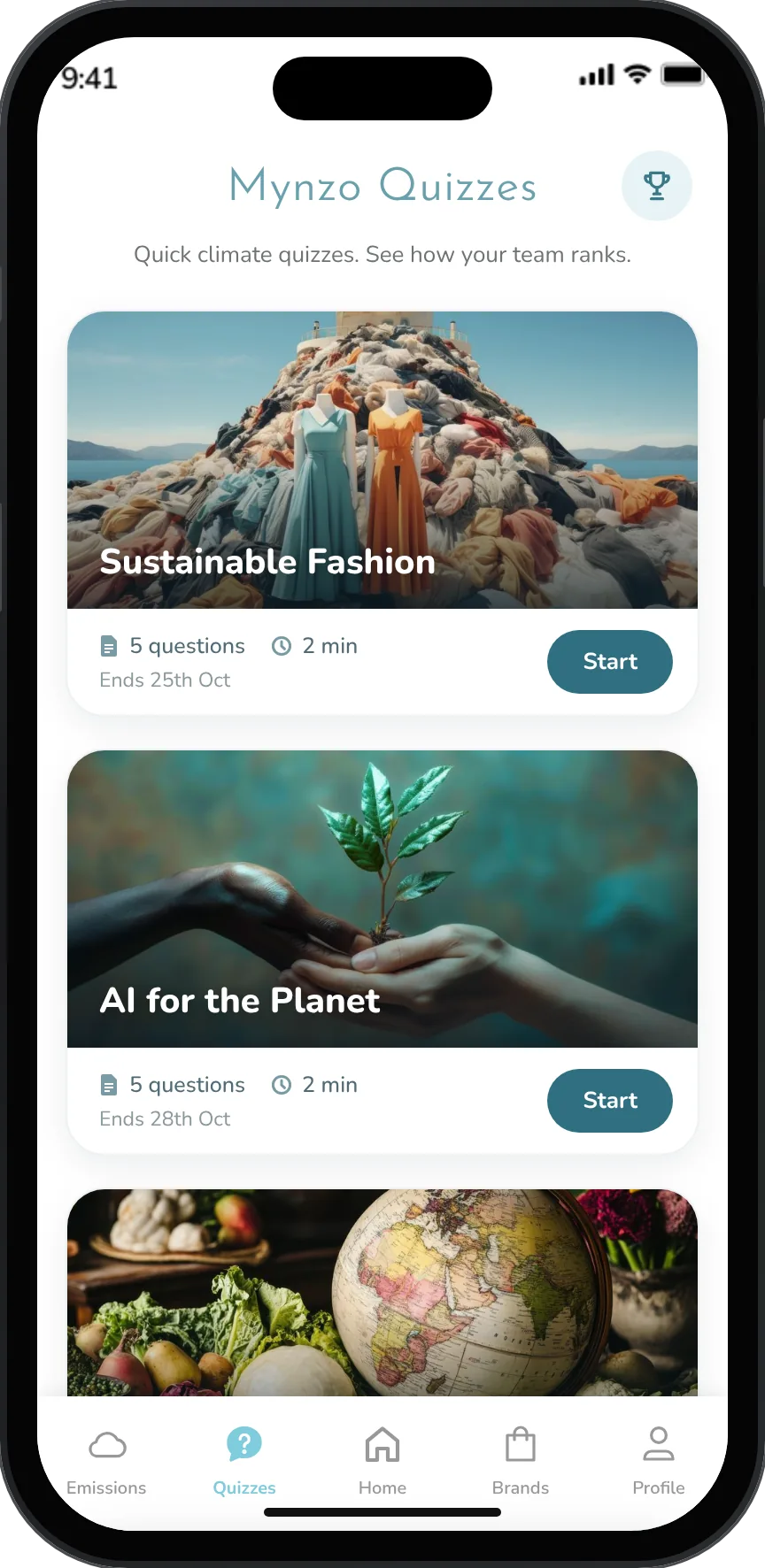
Quizzes are for people who have a minute, not an hour. Five new quizzes go live every week, each with five questions and about two minutes to play. A few rules keep every question quick to read and quick to answer.
Always about sustainabilityEvery quiz teaches something about living more sustainably.
Questions of 60 to 90 charactersShort enough to read at a glance.
Options of one or two wordsNo sentences to read, so an answer takes a tap.
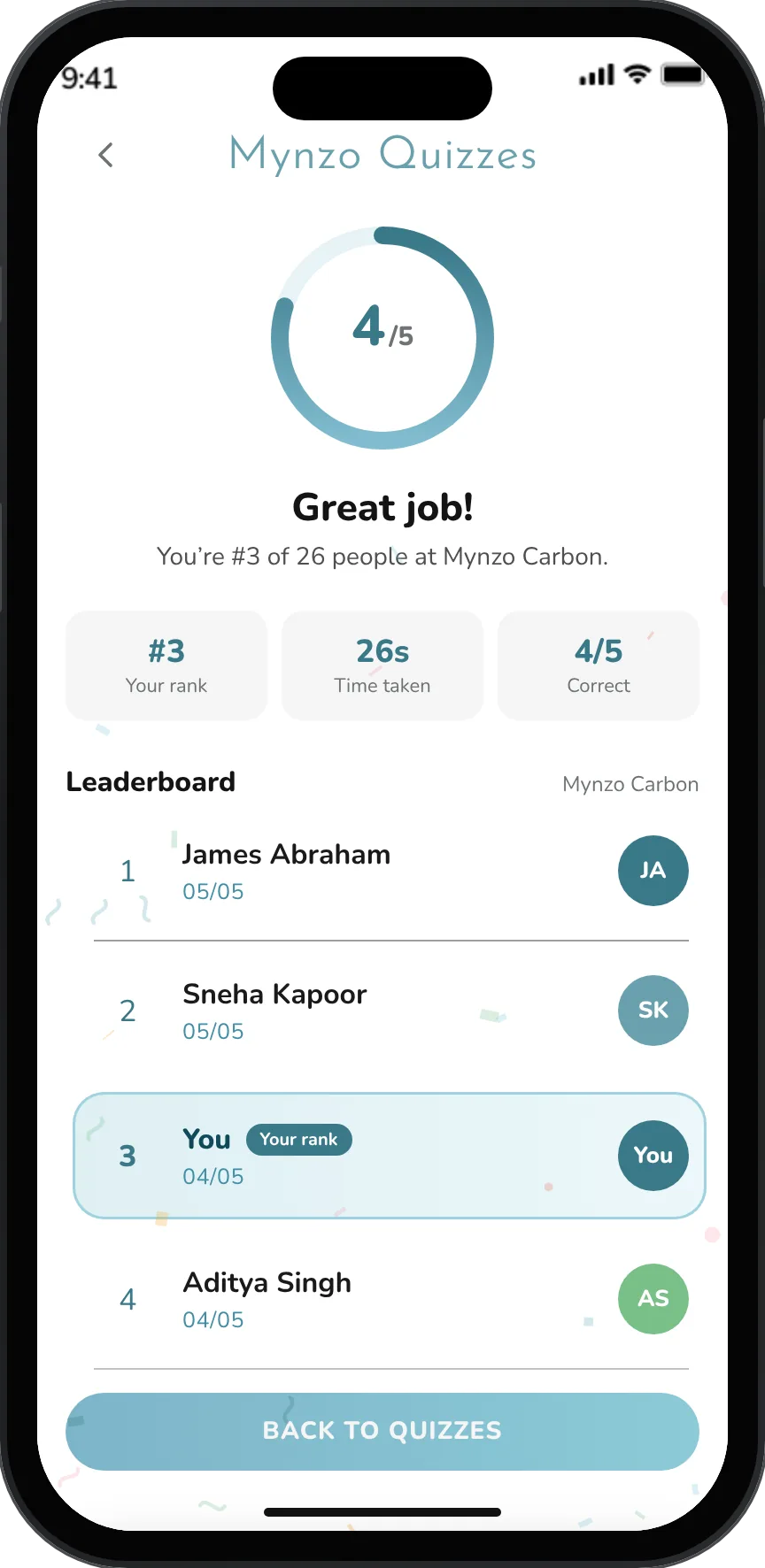
A leaderboardEmployees see where they stand in their organisation, and individuals see where they stand globally.
Quiz
Learning, in a minute
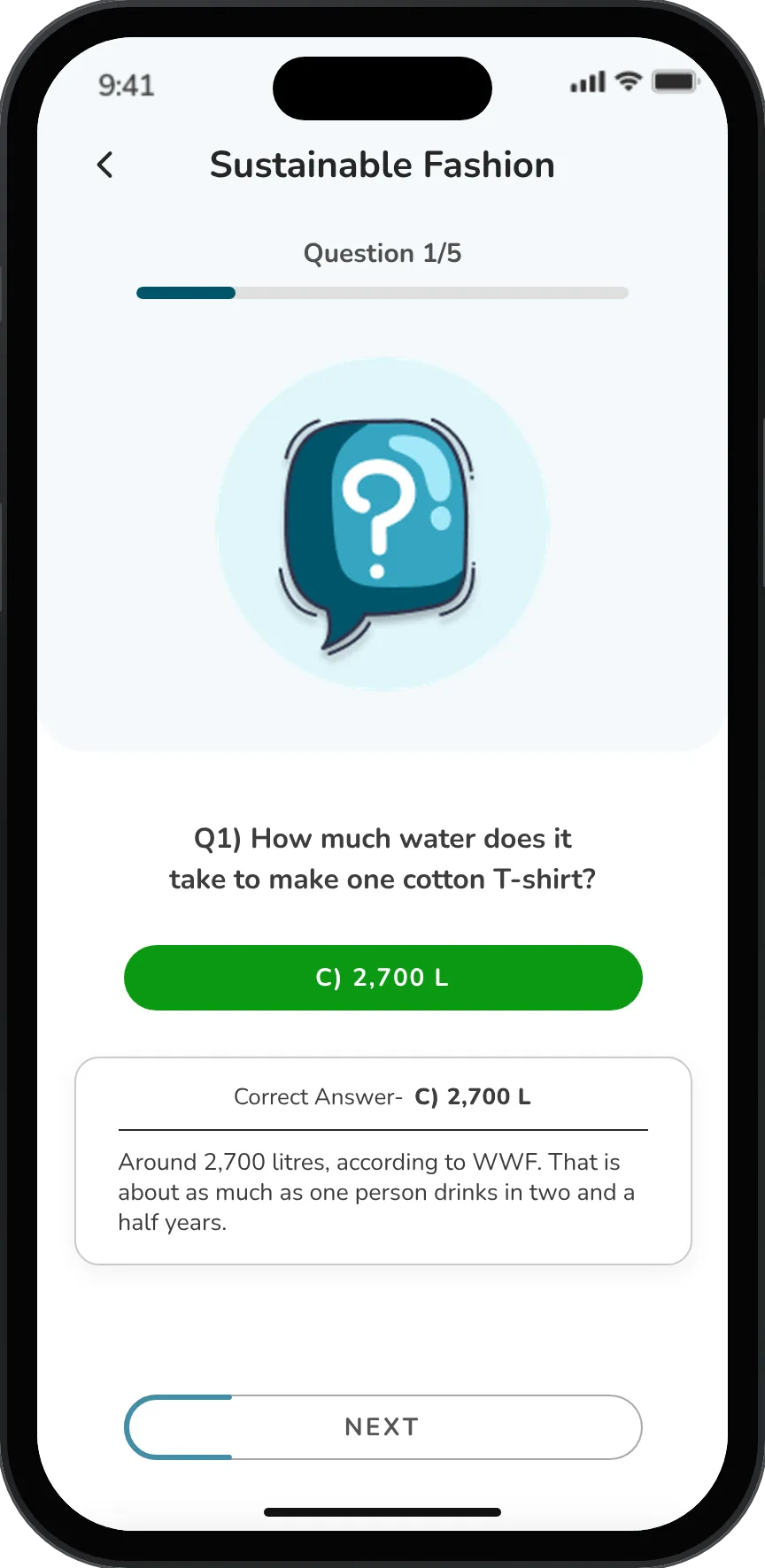
One question at a time, with the answer explained straight away.
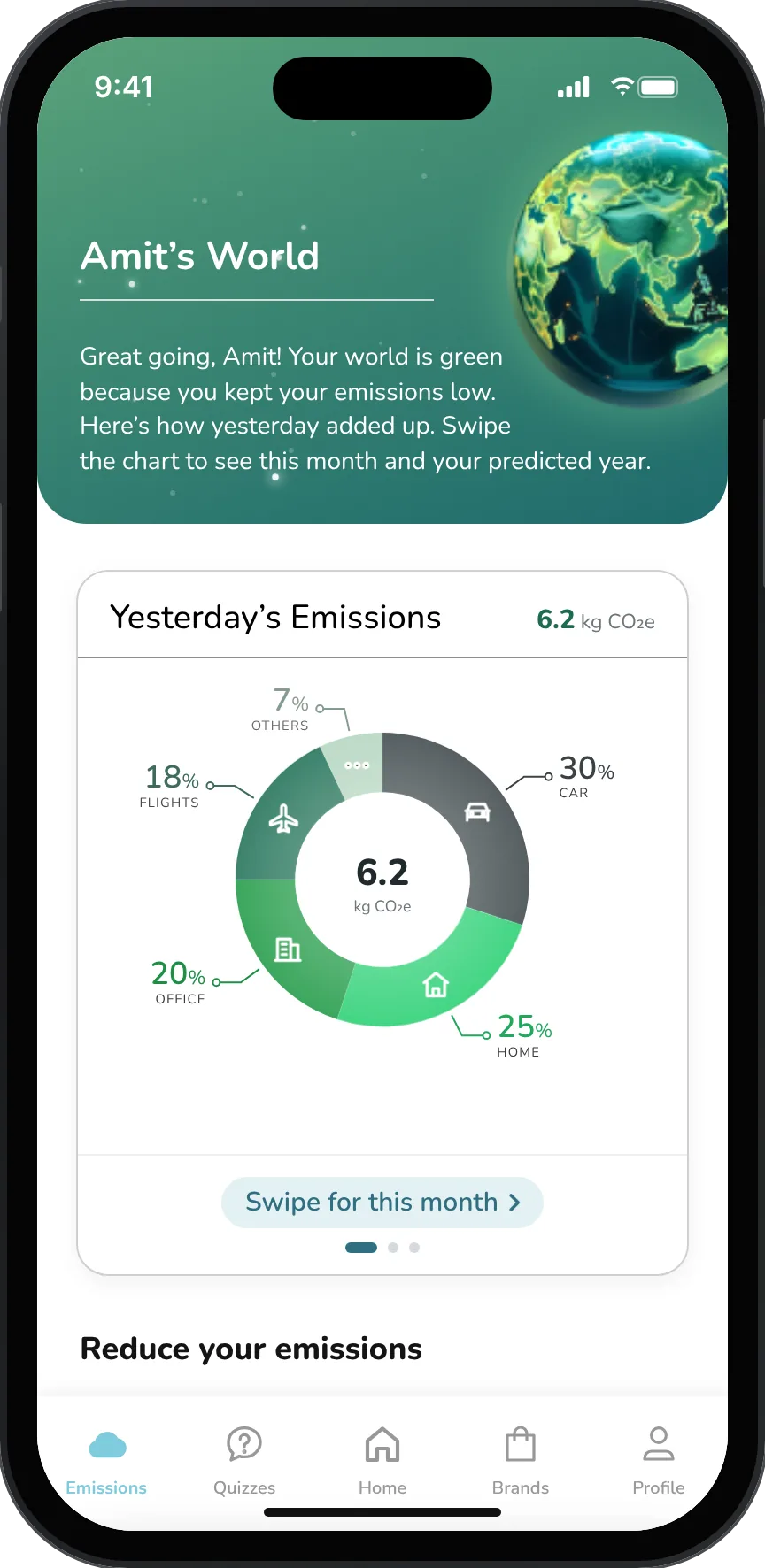
Three ways in. From Live Quizzes on Home, from the Quizzes tab, or from Take a quiz on the Emissions screen.
The answer explains itself. After each answer, the right one appears with a short explanation, often with its source.
A leaderboard. The result shows score, time and rank among colleagues, ranked by correct answers first and then speed.
Every quiz keeps its board. Quizzes already played stay under the trophy, each with its own leaderboard.
WhyThe people using the app are busy. A quiz works only if it fits into the gaps in their day.
The feed
A community feed people already know how to read
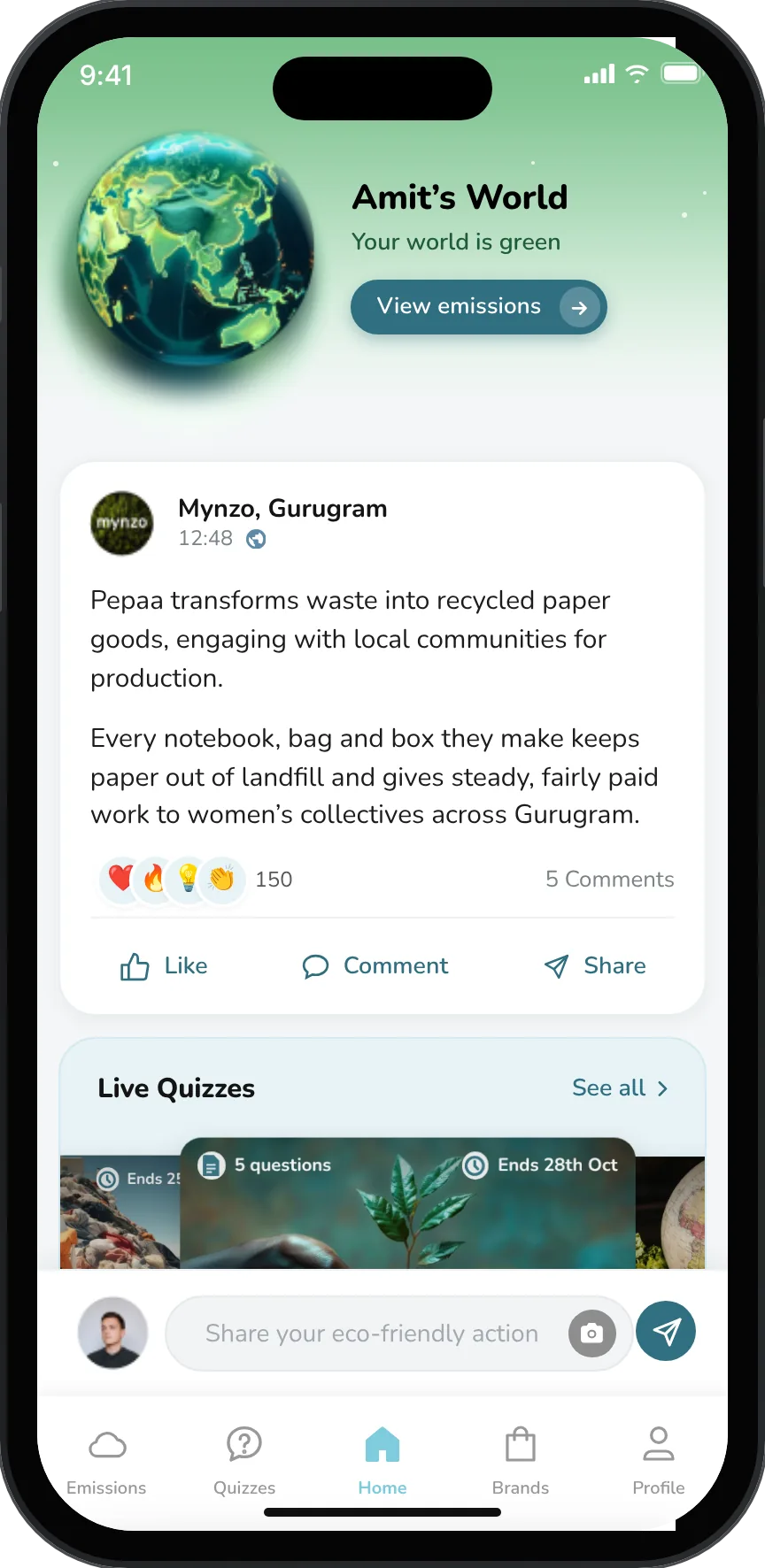
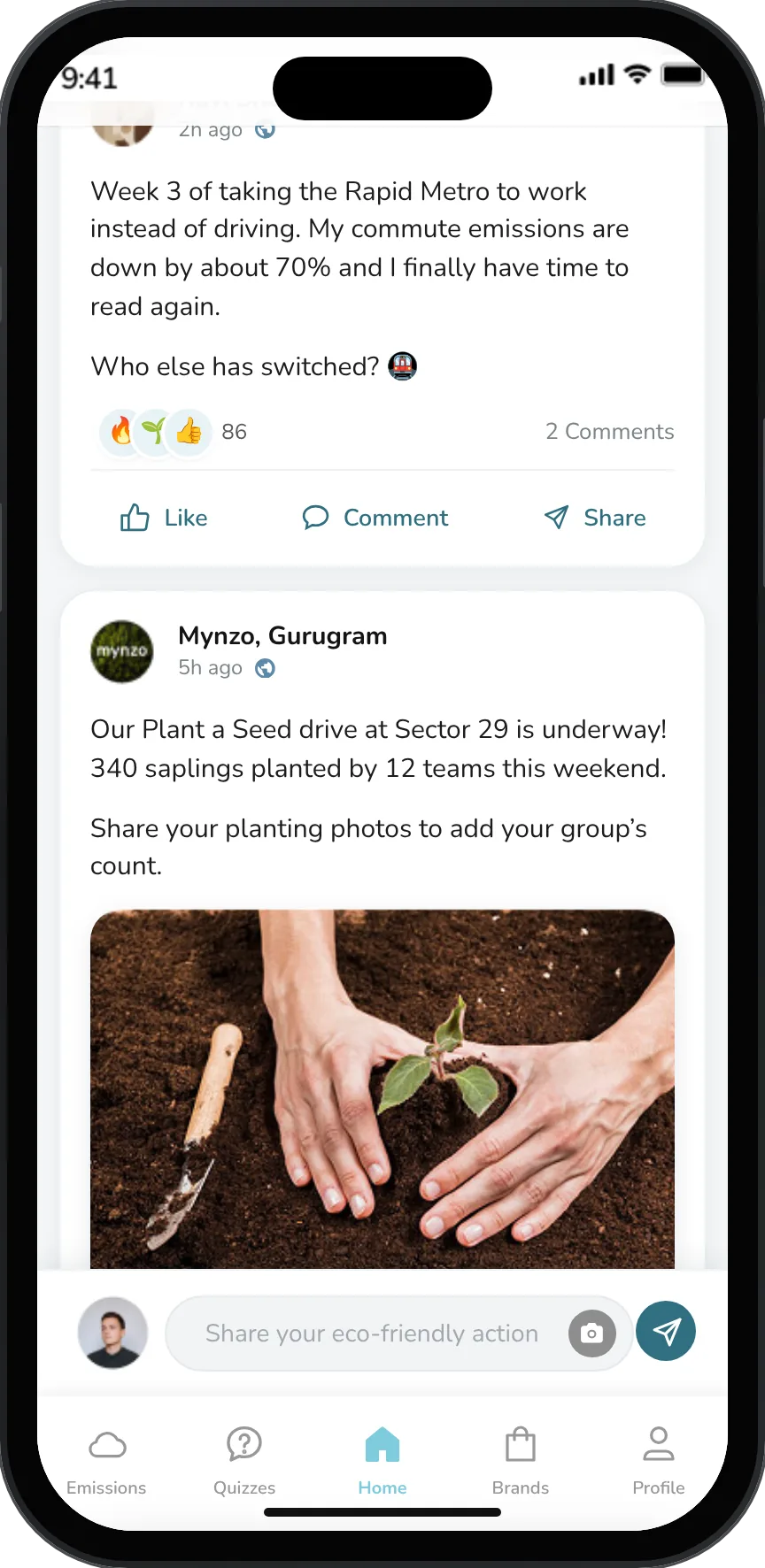
The feed is where people post what they are doing, how they feel, and what they think about their emissions or sustainability, and where they can comment on each other's posts. For a feed to work, people have to know how to use it the moment they open it. I based the layout on Instagram, in a light, easy-to-scan theme.
Facebook48.8%
Instagram48.3%
Share of India's internet users reached by the two community platforms we looked to, January 2024 (advertising reach, not confirmed usage). Both reach about half of internet users. I looked to platforms built around posts and comments, and based the layout on Instagram's pattern. YouTube is left out because it is built around video. DataReportal, Digital 2024: India. Source
Feed
Familiar by design
A feed of posts that works the way people already expect, so there is nothing new to learn.
A known pattern. People bring their experience of Instagram with them, so they know where to look and what to tap.
Light and easy to read. A light theme keeps the feed calm and easy to follow.
Posts with photos. The box at the bottom reads “Share your eco-friendly action”, and a photo can be added.
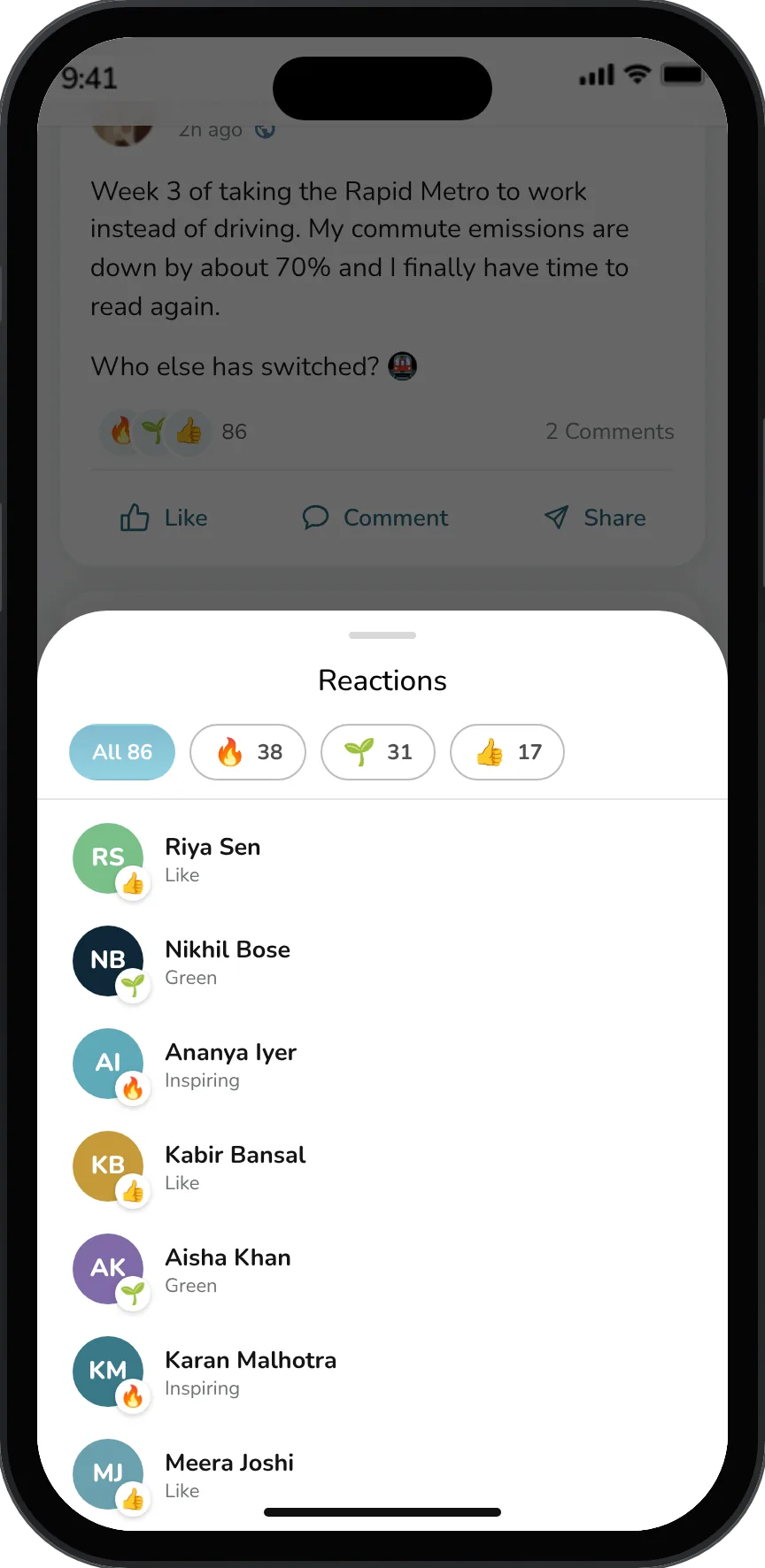
Reactions. Tap to like, or press and hold to pick a reaction. A sheet lists who reacted, filtered by reaction.
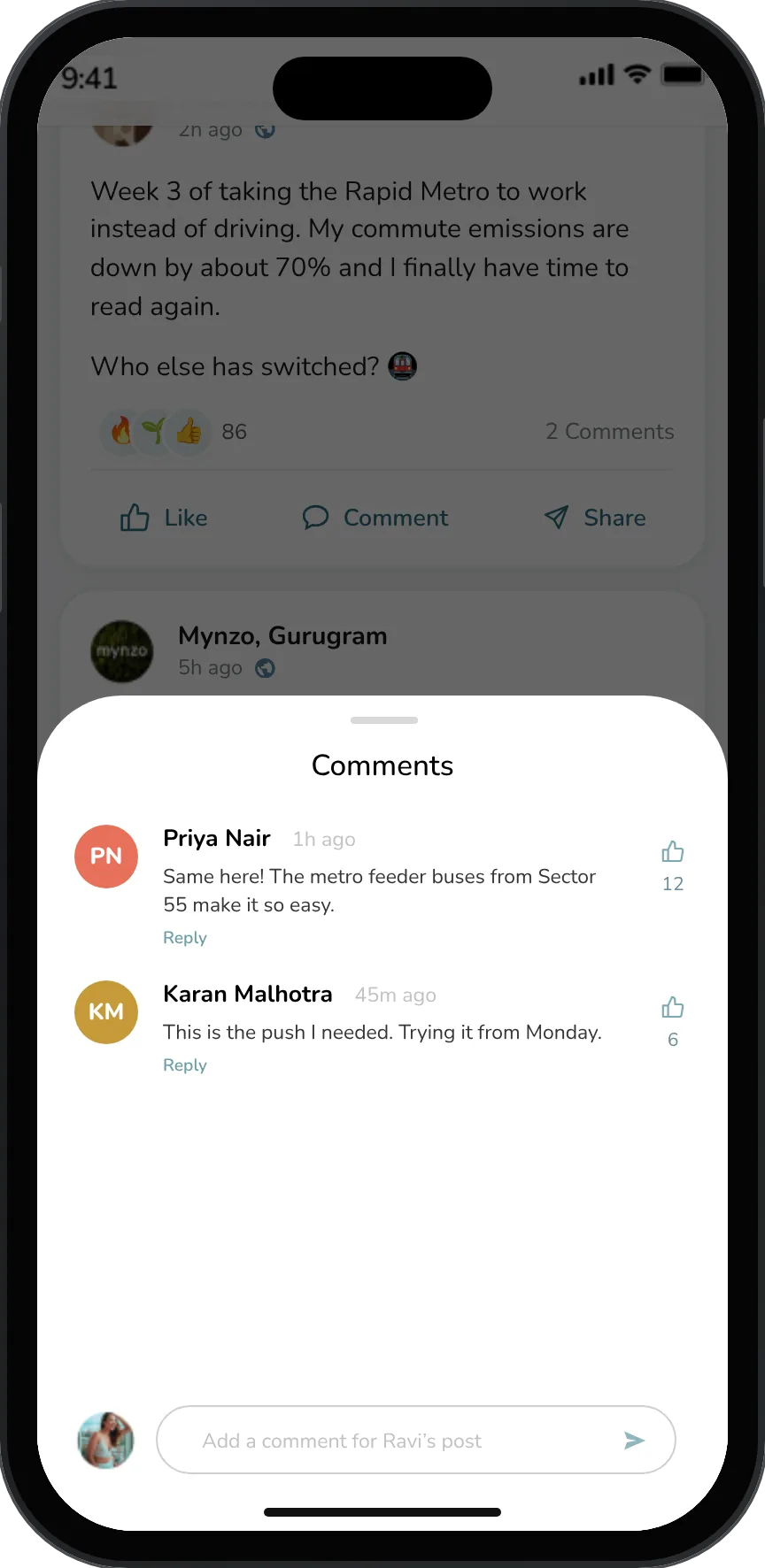
Comments with replies. Comments open in a sheet, with replies under each one.
WhyA community only forms if joining it is effortless, so I chose a pattern people do not have to learn.
Mynzo Selects
A curated list of brands worth choosing
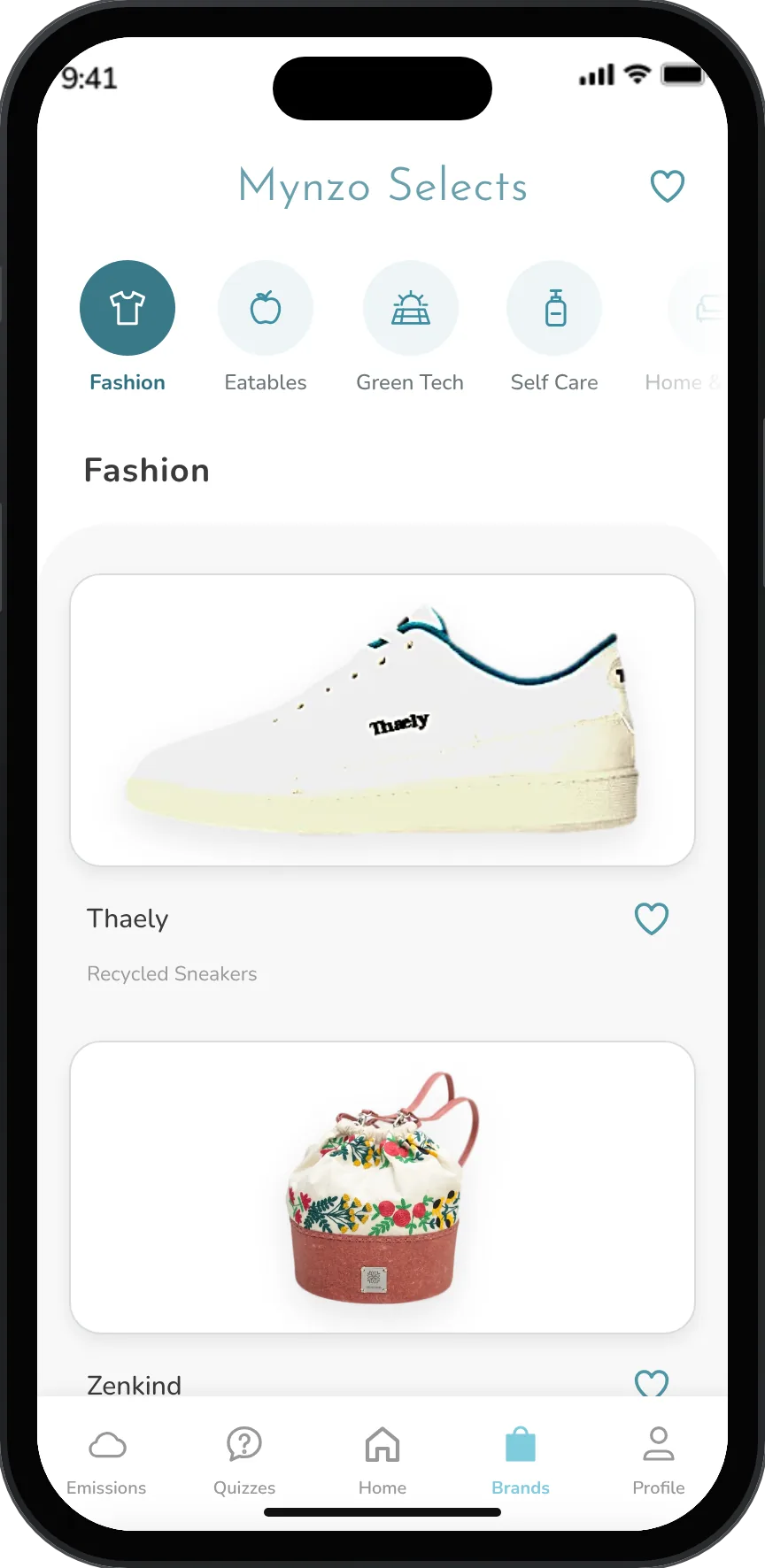
Knowing your emissions is one thing. Knowing what to choose instead is another. Mynzo Selects is a curated set of sustainable brands, so users have a real choice to make.
Brands
From knowing to choosing
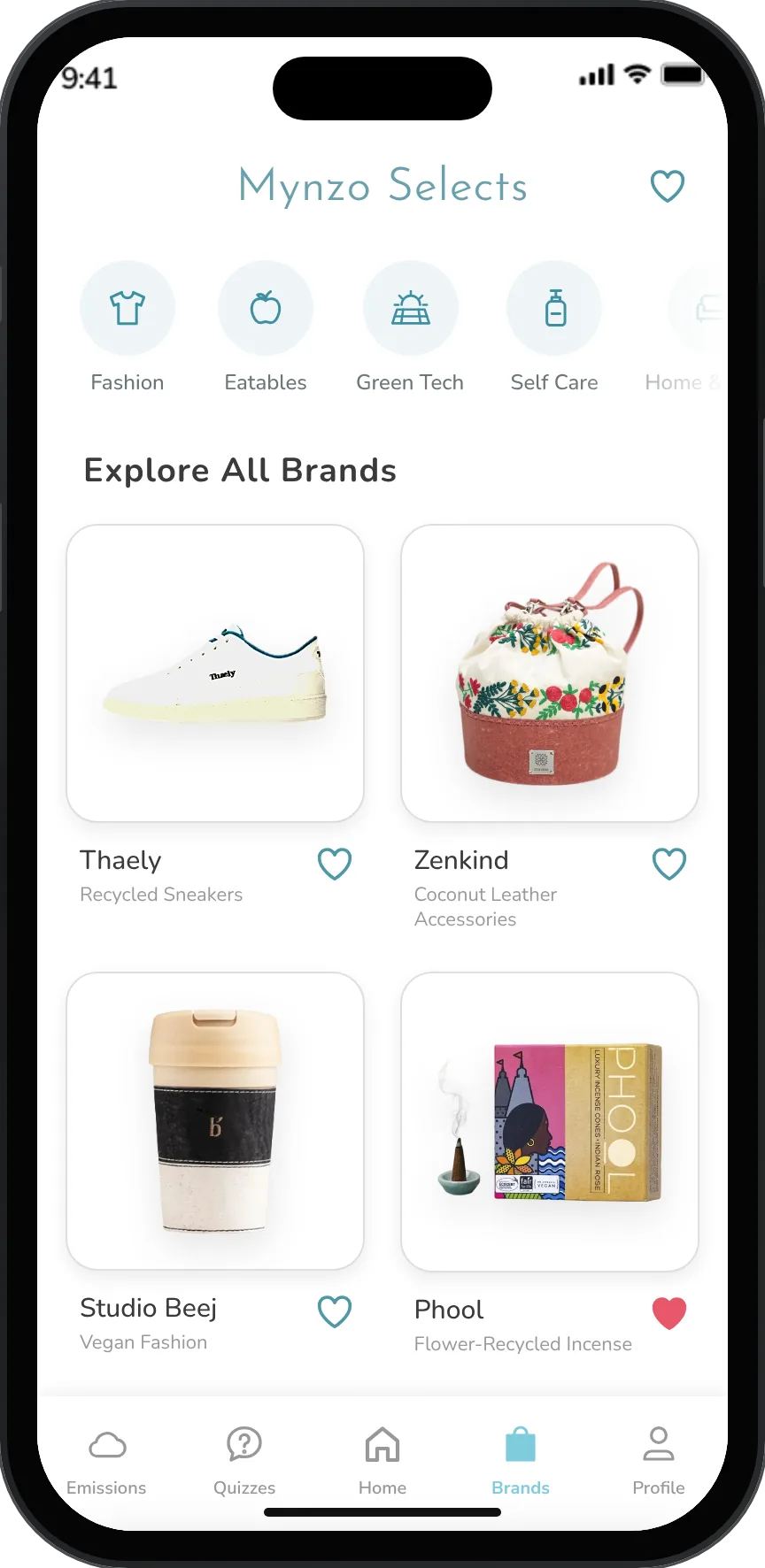
Brands to browse, each with the reason it is sustainable.
Browse by category. Fashion, Eatables, Green Tech, Self Care, and Home and Living.
Reviewed, not just listed. Each brand is reviewed for what its products are made of and how they are made.
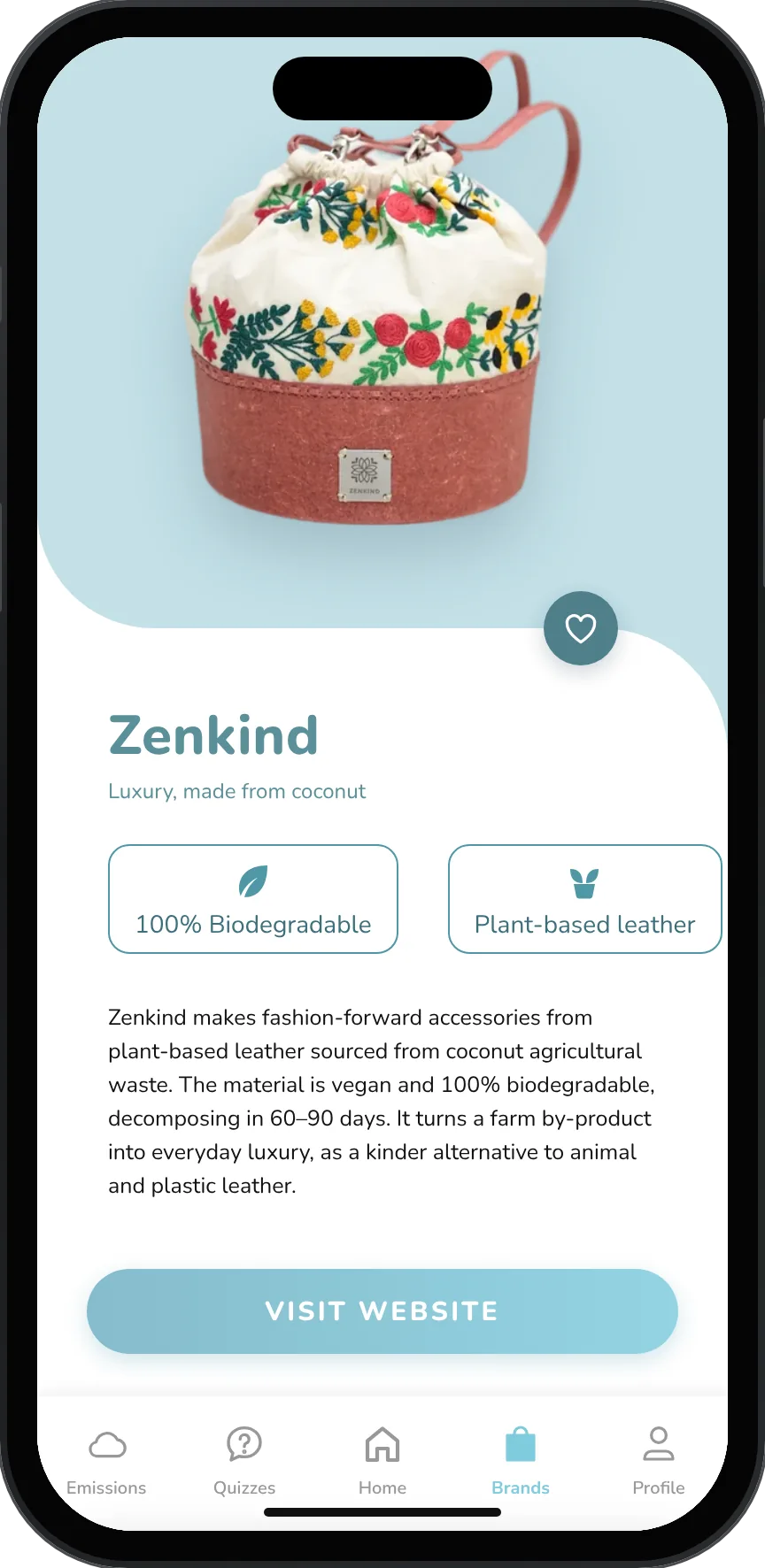
The reason at a glance. A brand page opens with a one-line tag and highlights like “100% Biodegradable”. Tapping a highlight shows more.
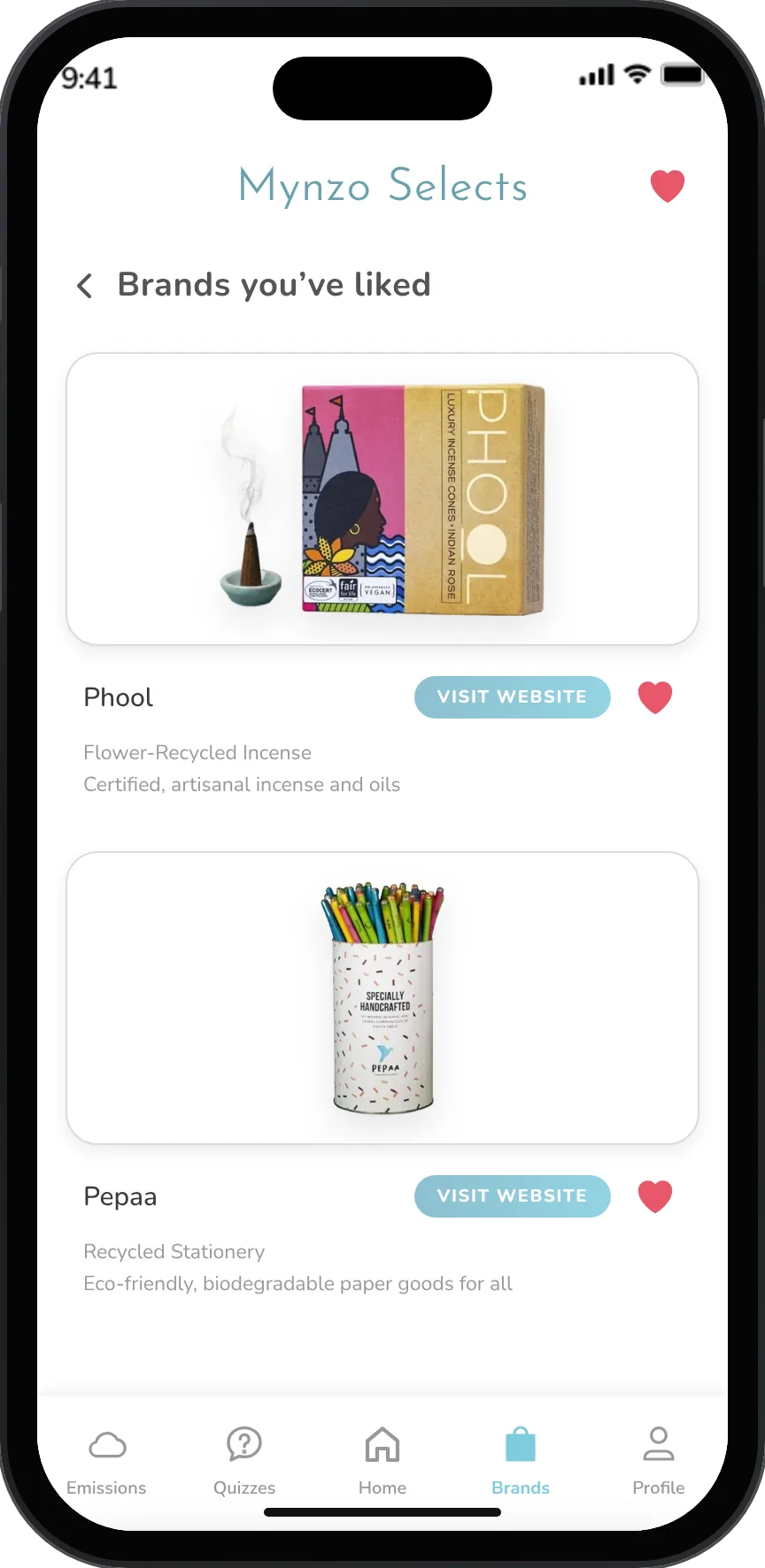
Favourites. A heart saves a brand to the list of brands the user has liked.
Visit website. Every brand page, and every saved brand, has a button that takes the user to the brand.
WhyA number shows what is wrong. A brand shows a choice the user can make today.
The look
A minimal, light theme
The app is kept minimal and light so the content leads. The calm look suits a topic people can find heavy, and it keeps screens easy to scan.
Design guidelines
A few simple rules
A light theme, with plenty of space around content
Short text, in short lines
Familiar patterns wherever one exists
Try the app
The real app, running on sample data
Tap through it the way a user would. The notes beside the phone follow the screen you are on.
Home
Try
04Reflect
What was built
Three features, built as the business allowed
Quizzes, the feed and Mynzo Selects are what is built. They answer the problem together: people learn, belong, and make sustainable choices. Build priorities were set with the business, and the other ideas on the list can follow as priorities allow.
How I would measure it
Did people come back and act?
The goal is action: people knowing what to do, and doing it, not time spent in the app. These are the measures I would track against a baseline from before the features launched.
Measure
What it tells us
Weekly return rate
How many users come back within a week of their last visit.
Mynzo Selects visits
How many users open a brand page, save a brand or visit its website.
Quiz completion
Whether people finish a quiz once they start, and how often they return for the next.
Emissions over time
Whether users who take quizzes and choose sustainable brands see their own emissions fall.
Feed posts per active user
Whether a community is forming, and who is joining it.
Reflection
What I would carry into the next project
What I did
Researched without first-hand data
We had little first-hand information about our users, so I turned to published research on the people the app is for. It gave the personas and the ideas a grounded start.
What I would do now
Go to the users first
I would interview employees and individuals, test a prototype with them, and agree on the return-rate measure before building anything.